
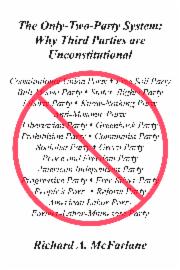
By a special arrangement with the publisher, Lex Scripta Legal Resaech Group, the Law Office of Richard A. McFarlane is pleased to offer
The Only-Two-Party System:
Why Third Parties are Unconstitutional
By
Richard A. McFarlane.
In the United States of America, third political parties are unconstitutional. In this context, “unconstitutional” does not mean illegal or even extralegal. It means incompatible with the governmental structure created by the Constitution of 1787, as amended and interpreted. In this context, “third political parties” means any group, however organized, which seeks to influence public policy primarily by nominating, campaigning for, and electing candidates to public office, especially to the Presidency and Congress, other than the two major parties, currently and since 1854 the Democratic Party and the Republican Party. This definition does not include any group which seeks to influence public policy by other means, such as circulating petitions, raising money, endorsing candidates nominated by one party or the other, bringing litigation, demonstrating, and so forth.
An unwritten constitution parallels and supplements the document drafted in 1787 at Philadelphia. This unwritten constitution is made up of “venerable Supreme Court opinions, landmark congressional statutes, and iconic presidential proclamations,” together with “textual silences, ... archaic assumptions,” and the political traditions and customs of the American people. The unwritten parts of the United States Constitution make more than two political parties unconstitutional. (Chapter Two.)
Third parties are unconstitutional because the structure of the government created by the Constitution, specifically the presidential system (Chapter Three) together with the apportionment of legislators in geographically-defined, single-seat constituencies at both the State and Federal levels (Chapter Four) and American political tradition does not allow any political party other than the two major parties — whether Democrats and Republicans, or Democratic-Republicans and Federalists — any space in which to function. Of course, the only-two-party system “has never been left to accomplish its wonders alone. It has been supplemented by primary laws, nomination laws, campaign-finance laws, and electoral rules that are heavily biased against the formation and maintenance of anything other than the two-party system.”
Narrow single-issue, or fringe parties such as the Greenback Party or the Populist Party of the late nineteenth century (Chapter Five) or factions of one of the two major parties such as the Progressive Party of Theodore Roosevelt in 1912 or the American Independent Party of George Wallace in 1968 (Chapter Six) have appeared from time to time. There have been a few independent candidates, such as H. Ross Perot, also. There are a few doctrinal parties (Chapter Seven) but these parties have placed themselves outside the political mainstream and have no political space in which to operate.
Unfortunately, as the Democrats and Republicans push farther to the extremes, and are less and less willing to negotiate and compromise, democracy is put at risk (Chapter Eight). Further, under even the best circumstances, the two-party system leaves about half of Americans unrepresented in Congress or the state legislatures.
Absent a general constitutional revision, which is unlikely and probably undesirable, there is very little we can do. A third party might replace one of the current two parties. This last scenario has happened before, and is the most likely to happen again. In the end, there is simply no place in the American body politic for more than two parties (Chapter Nine).